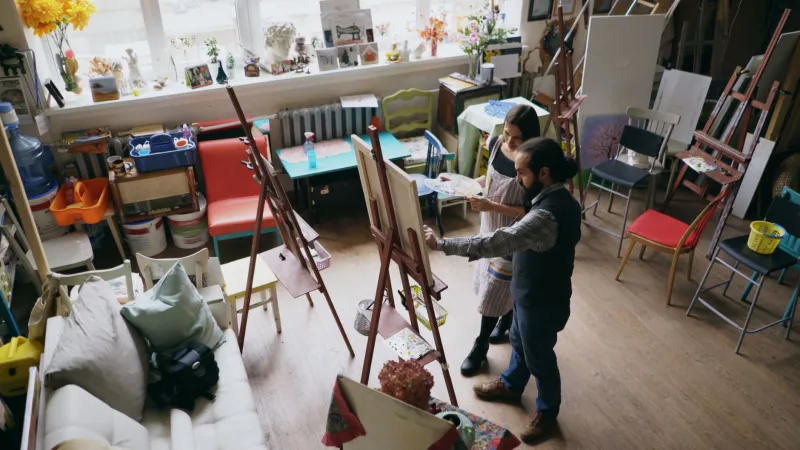
Too Many Cooks, Not Enough Canvas: The Hidden Dangers of Creative Collaboration

There's a specific kind of exhaustion that only creative people understand. It's not the tired you feel after a long day at your desk job. It's the hollow, slightly defeated feeling you get after sitting through a three-hour call where five people argued about font choices and nothing—absolutely nothing—got decided. Welcome to collaboration gone wrong.
Not all creative partnerships are disasters, of course. Some of the most extraordinary work in American art, music, and literature has come from two or more people building something together that neither could have built alone. But for every Lennon-McCartney, there are a dozen creative friendships that quietly imploded under the weight of unchecked egos, misaligned timelines, and the slow suffocation of compromise.
So how do you tell the difference before you're already three months in and resentful?
The Fantasy vs. The Reality
Most collaborations begin with a kind of giddy optimism that's almost impossible to resist. You meet someone at an opening, or through a mutual friend, or in an online community, and the conversation just flows. You finish each other's sentences. You have the same references. You both hate the same things about the current state of whatever creative field you're in.
So you decide to make something together.
The first few weeks are usually electric. There's the brainstorming phase, which feels like falling in love—every idea is brilliant, every tangent is worth exploring, every weird detour seems like it could lead somewhere magical. This is the part nobody warns you about: the beginning is almost always wonderful. The trouble starts when the work gets real.
Decisions have to be made. Deadlines appear. Somebody has to do the unsexy parts. And that's when you discover that your creative partner's "flexible" timeline means something entirely different than yours, that their idea of "minimal input" involves rewriting your sections, and that what you thought was shared vision was actually two separate visions wearing the same optimistic hat.
When Friction Is Fuel vs. When It's Just Friction
Here's the thing about creative disagreement: some of it is genuinely productive. The best collaborators push each other in ways that solo work can't replicate. A good creative partner will challenge your assumptions, call out your lazy choices, and drag you somewhere you wouldn't have gone alone. That's friction as fuel—uncomfortable in the moment, transformative in the long run.
But there's another kind of friction that doesn't generate heat, just damage. It happens when neither person is willing to yield because both feel like yielding means losing. When every suggestion is secretly a power move. When the work becomes secondary to the question of who controls it.
A muralist in Chicago once described a public art project she'd been hired to co-create with another artist as "six months of negotiating with someone who thought collaboration meant doing everything my way." She finished the project, but she walked away from the friendship. The mural exists. The relationship doesn't.
That's not a cautionary tale about collaboration itself—it's a cautionary tale about what happens when two people skip the part where they actually talk about how decisions get made.
The Committee Problem
Things get exponentially messier when you add more people. Two people can argue and resolve. Three people form coalitions. Four people start sending passive-aggressive emails. Five people schedule a meeting to talk about the meeting.
If you've ever been part of a creative project with a steering committee, a feedback panel, or—God help you—a stakeholder group, you know exactly what I'm talking about. The more voices you add, the more the work gets sanded down into something that offends no one and moves no one. It becomes beige. Competent, technically proficient, and utterly forgettable.
This is the committee trap: the assumption that more input equals better output. In creative work, that's almost never true. What more input usually equals is more compromise—and compromise, when it's applied to the core of a creative idea, tends to hollow it out.
Walking Away Without Burning It All Down
Sometimes the right move is to exit. Not dramatically, not with a manifesto—just honestly. "This isn't working for me" is a complete sentence, and it's one more creative people need to be comfortable saying before they've spent a year of their life on something that makes them miserable.
The trick is recognizing the signs early enough that walking away is still a clean break rather than a scorched-earth situation. Watch for the moment when you start dreading the check-ins. Notice when your best ideas are ones you're keeping to yourself because you don't want them picked apart. Pay attention to whether you feel energized or depleted after working sessions.
Your gut usually knows before your brain catches up.
The Unexpected Gift of Surrender
Here's the plot twist, though: sometimes the magic happens precisely because you don't get your way.
A novelist who spent a decade writing alone finally agreed to co-author a thriller with a writing partner she met at a residency in Vermont. The process was chaotic. They disagreed on structure, on voice, on the ending—especially the ending. She eventually let her partner have the last word on the final chapter, a decision she describes as "one of the hardest and best things I've ever done for my work."
The book got picked up. Readers consistently cite the ending as the strongest part.
Surrender isn't the same as losing. Sometimes it's the most creative act available to you—the choice to trust someone else's instincts and discover that they were right. The key is knowing the difference between strategic surrender and slow erosion. One is a choice you make from a position of confidence. The other is what happens when you stop fighting for your work because you're just too tired to keep going.
Before You Sign On
If you're considering a creative collaboration—whether it's a co-authored project, a joint exhibition, a podcast, or anything else—do yourself a favor and have the awkward conversation first. Talk about decision-making. Talk about credit. Talk about what happens when you disagree. Talk about what "done" looks like and when.
It's not romantic. It's not the fun part. But it's the part that determines whether your partnership produces something extraordinary or just produces resentment.
The best collaborations are the ones where both people feel like they made something they couldn't have made alone—and where both people still want to be in the same room at the end of it. That's the bar. It's not a low one, but it's worth aiming for.