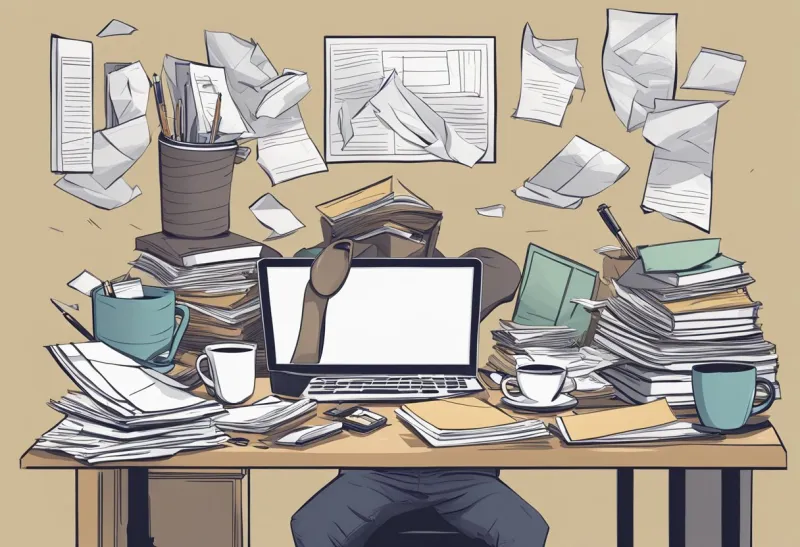
Let Them See the Mess: Why Sharing Unfinished Work Might Be Your Bravest Creative Move

Photo by Photo by C. Shi on Unsplash on Unsplash
I used to hide everything.
Sketchbooks stayed in drawers. Half-written essays lived in folders with names like "maybe someday" and "not yet." I had this vision in my head — this perfect, finished version of whatever I was making — and I was convinced that showing anything less would somehow invalidate the whole project. Like a magician who trips over the rabbit before the trick is done.
Then I watched someone post a blurry photo of a painting they'd barely started. Just a pencil outline on raw canvas, accompanied by a caption that said something like, this is day one and I have no idea what I'm doing. The comments flooded in. People were captivated. They asked questions, offered encouragement, shared their own half-finished things. And I thought: oh. Oh, that's the whole point.
The Myth of the Grand Reveal
We've been sold a very specific story about creative work. You labor in private, you perfect the thing, and then — cue the velvet curtain — you present it to the world in its most polished, impressive form. The audience gasps. The work is celebrated. Everyone goes home satisfied.
But that model is increasingly out of step with how people actually connect with art and artists. We live in an age where audiences don't just want the finished painting on the gallery wall — they want to watch you mix the colors. They want the studio tour, the blooper reel, the journal entry from the day you almost quit.
This isn't a lowering of standards. It's a shift in what we value. And honestly? It's a shift that's been good for creativity.
Artists like Austin Kleon have built entire careers around the idea that showing your work — the process, the influences, the experiments that didn't pan out — is itself a form of creative expression. Writers like Anne Lamott made "shitty first drafts" a rallying cry for an entire generation of people who thought they had to be brilliant from the first sentence. The message keeps surfacing because it keeps being true: the mess is where the real story lives.
What You're Actually Afraid Of
Let's be honest about the fear, though, because it's real and it deserves to be named.
Sharing unfinished work feels risky because it removes the buffer of completion. A finished piece can be defended. You can say, I meant to do that. A rough draft or a work-in-progress doesn't have that armor. It's vulnerable in a way that finished work simply isn't.
You're afraid someone will judge the potential before it's had a chance to become the thing. You're afraid they'll see the gap between where you are and where you're trying to go, and they'll think less of you for it. You're afraid that sharing the sketch means forfeiting the right to the painting.
Here's what I've come to believe, though: most people aren't looking at your unfinished work and thinking this person isn't good enough. They're thinking this person is brave enough. There's a massive difference.
The Loyalty That Process Builds
Some of the most devoted creative audiences in the world aren't following artists because of a single finished masterpiece. They're following because they watched the whole journey — they were there for the early experiments, the pivots, the moments of doubt that got worked through publicly.
Think about the YouTube channels where artists paint in real time, or the Instagram accounts that document a novelist's daily word count. These creators aren't just sharing work; they're inviting people into a relationship with the creative process itself. And that relationship is stickier than any gallery opening.
When someone watches you struggle with something and then watches you solve it, they feel like they're part of the solution. They have skin in the game. That's not an audience — that's a community.
How to Actually Do It Without Spiraling
Okay, so you're convinced. Or at least curious. Here's how to start sharing work-in-progress without completely losing your mind.
Start small and low-stakes. You don't have to post your half-finished novel chapter to a public blog. Share a photo of your desk. Show the color swatches you're considering. Post a sentence you wrote that you love but don't know where it fits yet. Ease into the vulnerability.
Frame it with intention. There's a difference between "here's my mess, sorry" and "here's where I am right now, and I'm curious where it's going." The second framing invites conversation without requiring an apology. You're not showing weakness — you're offering a window.
Separate the sharing from the feedback. You don't have to ask for critique every time you show unfinished work. Sometimes you're just documenting. Sometimes you're just saying this exists and I'm working on it. That's enough.
Give yourself permission to evolve publicly. The work you share today doesn't have to match the work you share six months from now. In fact, it shouldn't. The whole point is that people get to watch you grow.
The Work That Doesn't Wait for Permission
There's something that happens when you start sharing before you feel ready: you stop waiting for permission. You stop treating your creative life like something that only becomes real once it's been approved by an imaginary panel of judges. You start treating it like what it actually is — an ongoing, living, evolving practice.
The rough draft doesn't need to be hidden. The sketch doesn't need to be perfect before someone sees it. Your half-formed idea, your experiment that might fail, your work at 11 PM when you're not sure if it's good — all of it is part of the story.
And honestly? The story is what people are here for.
So let them see the mess. Not because the mess is the destination, but because the mess is the truth. And truth, even when it's unpolished and a little scary to look at, is always worth sharing.