The Murky Middle: Surviving the Part of a Big Creative Project Nobody Talks About
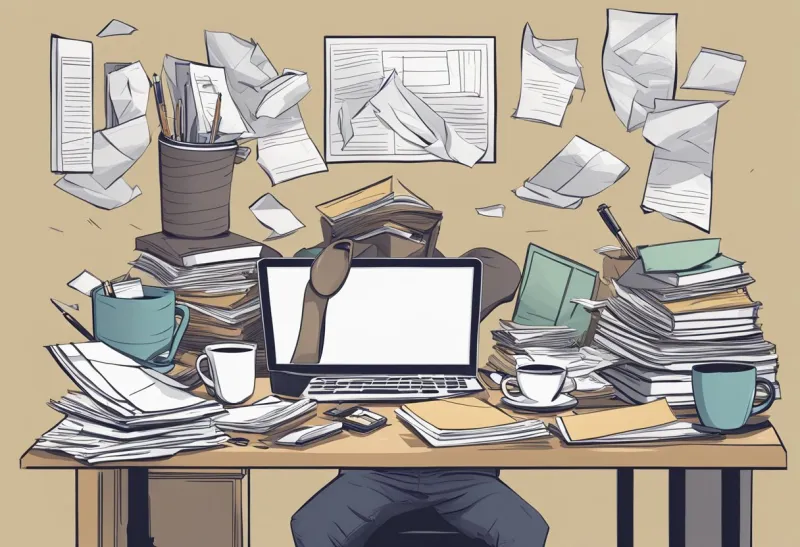
Photo: writer desk messy drafts notebook creative struggle working, via learningmole.com
Here's the part of the creative process nobody puts on their mood board: it's week eleven of a project you were genuinely excited about, and you hate it. Not in the productive, "I'm pushing through resistance" way. In the flat, fluorescent-lit way where you open the file and feel nothing. Where the original idea — the one that felt so alive back in September — now looks like something a stranger made, and not a particularly interesting stranger.
Welcome to the middle. Population: everyone who's ever tried to make something big.
We talk a lot about beginnings in creative culture. The spark, the concept, the beautiful chaos of early drafts and fresh canvases. We also celebrate endings — the launch, the opening, the finished manuscript. But the middle? That long, grinding, often demoralizing stretch between inspiration and completion? That gets glossed over. And because it gets glossed over, a lot of people assume that struggling through it means something is wrong with them, or with their project.
It doesn't. It means they're doing it right.
Why the Middle Feels Like Quicksand
There's a psychological reason the middle of a long project is so brutal, and it has to do with what behavioral researchers call the "motivational dip." Early on, novelty and excitement do a lot of the heavy lifting. Your brain is flooded with dopamine every time you sit down to work because everything is new and the possibilities feel limitless. Near the end, proximity to completion kicks in — the goal is visible, which creates its own momentum.
But in the middle? Neither of those engines is running. The novelty has worn off. The finish line is still too far away to feel real. And you're also, by this point, intimately acquainted with every flaw and limitation of your project in a way you weren't at the start. You know exactly what it isn't. You're not yet sure what it is.
Novelist and writing teacher Dana Reardon, who has published six books and teaches creative writing at a small liberal arts college in Vermont, calls this phase "the valley of accurate information."
"At the beginning, you don't know enough about your project to be discouraged," she explains. "By the middle, you know everything that's wrong with it and nothing about whether those problems are fixable. That's genuinely hard information to hold. Most people interpret that difficulty as a sign to quit. It's actually a sign that you're deep enough in to do the real work."
What Experienced Creatives Actually Do
I've spent the last several months asking working artists, writers, filmmakers, and makers one question: what do you actually do when a big project loses its momentum? The answers surprised me — not because they were counterintuitive, but because they were so specific and so unglamorous.
They lower the daily bar. Graphic novelist and illustrator Tomás Reyes, whose debut graphic novel took four years to complete, swears by what he calls "the ugly page" rule. "When I'm in the middle and I don't want to work, I give myself permission to make one ugly, bad, throwaway page. Just to prove I showed up. About half the time, the ugly page turns into something I actually keep. The other half, I have one ugly page. Either way, I didn't quit."
They change the physical context. Ceramic artist and studio owner Jess Whitmore has a second, smaller workspace — a corner of her garage with worse lighting and no good tools — that she uses specifically when she's stuck. "Something about being in a different space, even an inferior one, breaks the pattern. My brain stops associating the work with the frustration I've been feeling at my main studio. It's a reset."
They reconnect with the original reason. Memoirist and essayist Kevin Park keeps a document he calls "the why file" for every major project. It's a single page he writes on day one, when the idea is still electric, explaining in messy, unedited language why this project matters to him. "On the bad days in the middle, I read it. Not to feel inspired — that's too much to ask. Just to remember that there was a version of me who thought this was worth doing. I try to trust that guy."
The Myth of Consistent Motivation
One of the most damaging stories we tell about creative work is that sustained motivation is both possible and necessary. It isn't. Even the most prolific, celebrated artists in any field will tell you that most of their working hours feel like work — effortful, sometimes tedious, frequently unrewarding in the moment.
What separates the people who finish from the people who don't isn't a superior capacity for enthusiasm. It's a willingness to keep showing up when enthusiasm is absent.
Filmmaker and podcast host Adrienne Chu, who spent three years on an independent documentary before it screened at a regional film festival last spring, put it plainly: "I had maybe thirty days over the whole three years where I felt genuinely excited to work on it. The rest were just days where I worked on it anyway. The film doesn't know the difference."
This is worth sitting with. The finished thing does not carry a record of how you felt while making it. Your audience will never know which chapters you wrote while inspired and which ones you dragged out of yourself on a gray Tuesday. The work holds the work, not the emotional weather around it.
Structural Tricks That Actually Help
Beyond mindset, there are practical structural moves that working creatives use to navigate the middle without losing the thread.
Break the timeline into micro-projects. Instead of thinking about the novel or the album or the series as one massive thing, treat each chapter, each track, each piece as its own complete unit with its own small finish line. Completion, even partial completion, releases motivation.
Schedule a mid-project review. Set a deliberate checkpoint — not to evaluate whether to continue, but to consciously reassess the scope, timeline, and goals. Many projects fail in the middle because the original plan no longer fits the project that's actually emerging. Giving yourself permission to adjust isn't quitting; it's calibrating.
Find an accountability structure that costs you something. Whether that's a writing group, a studio visit, a check-in with a collaborator, or even a public commitment — having something external that makes you show up removes the daily negotiation with yourself about whether today is the day you work. It just is.
Read or look at work you love in your medium. Not to compare. Not to study. Just to remember why the form matters to you. Dana Reardon rereads the first fifty pages of a novel she loves every time she hits the valley. "It doesn't make me want to write a better book. It makes me want to write my book. That's enough."
The Middle Is Where the Work Becomes Yours
Here's the thing I keep coming back to, after all these conversations: the middle is where most people leave. Which means it's also where the field thins. The people who make it through aren't necessarily more talented or more disciplined or more creatively gifted. They've just made peace — or at least a grudging truce — with the fact that difficulty is not a signal to stop. It's a signal that you're in it.
Every piece of work I'm proudest of has a middle I barely survived. I suspect the same is true for most creatives, if they're being honest.
So if you're in the murky middle of something right now — exhausted, uncertain, half-convinced it was a bad idea from the start — I'd gently suggest: stay. Make the ugly page. Trust the person who started this. The middle doesn't last forever.
The finish line is just further away than it looked from the beginning. That's all.