Ink on Paper, Heart on Sleeve: Why Handwritten Letters Are the Most Honest Art Form Left
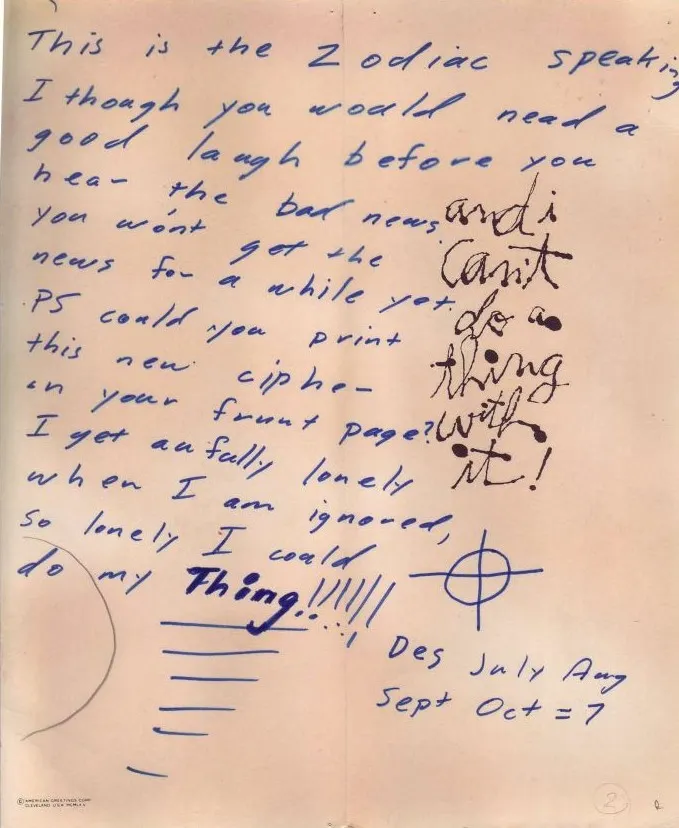
Photo: Zodiac Killer, Public domain, via Wikimedia Commons
There's a shoebox under my bed that I haven't opened in years. Inside it are letters — real ones, written in ballpoint and fountain pen on paper that's gone slightly soft at the edges. Some are from college friends. One is from a professor who changed the way I thought about storytelling. A few are from people I've lost touch with entirely. I know, without opening the box, that every single one of them will wreck me a little.
You can't say that about your inbox.
We live in an age where communication has never been faster, cheaper, or more abundant — and somehow, also never felt more disposable. So when I started noticing a quiet resurgence of interest in handwritten letters among artists and writers I admire, I got curious. Was this nostalgia? Aesthetic posturing? Or is there something genuinely, functionally different about the way a handwritten letter tells a story?
Spoiler: it's the last one.
The Body Remembers What the Keyboard Forgets
When you type, your hands do the same thing regardless of what you're writing. A grocery list and a love letter require identical physical gestures. But when you write by hand, your body is in the story. Your pen pressure changes when you're nervous. Your letters crowd together when you're rushing. You cross things out — and those crossed-out words stay visible, a little ghost of the thought you almost sent.
New York-based mixed-media artist and zine-maker Callie Ostrowski has been incorporating handwritten letters into her visual art practice for nearly a decade. She describes the physical act of writing as a kind of involuntary honesty. "When I type, I edit constantly. I delete before the thought is even finished," she told me over the phone. "But when I'm writing by hand, there's this commitment that happens. The word is already on the page before I've decided whether I mean it. And sometimes that's the most true version of what I was trying to say."
Researchers at Princeton and UCLA famously found that students who took notes by hand retained information more deeply than those who typed — not because they wrote more, but because they were forced to synthesize and paraphrase in real time. The same principle applies to creative writing. Slowing down creates space for something unexpected to surface.
Letters as Artistic Artifacts
The epistolary tradition — storytelling through letters — has given us some of the most emotionally complex work in the literary canon. Think of the gut-punch intimacy of The Color Purple, the slow-burn tension of Frankenstein, the devastating restraint of Les Liaisons Dangereuses. These aren't just novels that happen to use letters as a structural device. The letter format is the story. The gap between what characters write and what they mean, between what they send and what they keep — that's where the drama lives.
Contemporary writers are returning to this format with fresh eyes. Portland-based author and essayist Marcus Tilden spent two years writing what he calls a "correspondence novel" — a project that began as an actual exchange of handwritten letters between himself and a childhood friend, and eventually became the structural backbone of a memoir he's currently shopping to publishers.
"I didn't set out to write a book," he said. "I just wanted to reconnect with someone I'd lost track of. But something about having to physically write to him — knowing he'd hold the paper I touched — made me tell the truth in ways I'd been avoiding for years. The book came out of that honesty."
He still has every letter his friend sent back. He's framed two of them.
The Letter That Changed Everything
Ask any working writer or artist about a piece of correspondence that mattered, and watch their face change. Almost everyone has one.
Illustrator and author Priya Nambiar received a handwritten note from a picture book author she'd admired since childhood after she sent fan mail — actual fan mail, in an envelope with a stamp — to her publisher. The note was four sentences long. It told Priya that her own illustration samples, which she'd included on a whim, showed "a real and specific point of view."
"I'd been second-guessing my style for years," Priya told me. "I'd been trying to make my work look more like what I thought publishers wanted. That letter made me stop doing that. I submitted my actual work, in my actual style, six months later, and got my first book deal."
She keeps the note in a frame above her drafting table.
There's something about a handwritten note that carries weight in a way that an email — even a thoughtful, generous email — simply doesn't. It required someone's time in a different way. It required them to find paper, find a pen, write without a backspace key, find an envelope, address it, stamp it, and physically take it somewhere. That chain of small, deliberate choices is embedded in the object itself. You feel it when you hold it.
Starting Your Own Practice
You don't have to be a professional writer to experiment with this. In fact, the less pressure you put on it, the better.
A few things worth trying:
Write to someone you've been meaning to reach. Not a text. Not an email. A real letter. It doesn't have to be long. It doesn't have to be beautiful. It just has to be honest.
Keep a handwritten journal alongside your digital work. Many creatives find that their best ideas — the ones they actually use — emerge when they're writing by hand, away from screens.
Try writing a scene or a story section by hand first. Even if you type it up later, the original draft will carry a texture and spontaneity that's hard to manufacture at a keyboard.
Save the letters you receive. In twenty years, you won't remember most of your text conversations. You'll remember the letters.
The Slowness Is the Point
I think what we're really talking about, when we talk about handwritten letters, is the value of deliberate slowness in creative work. In a culture that rewards speed, volume, and constant output, the letter insists on something different. It says: this thought was worth the time it took to form. This person was worth the effort of the stamp.
Art, at its best, makes the same argument. The stories worth telling are the ones we took seriously enough to slow down for.
Maybe that's why the shoebox under my bed still feels so loaded. Every letter in it is proof that someone, at some point, thought I was worth the slowness.
That's a hard thing to replicate with a notification ping.